Selling Omega-3 and Fish Oil Supplements in China
Selling Omega-3 and Fish Oil Supplements in China
A billion-dollar cross-border e-commerce category growing 25% year-on-year, with foreign brands leading the charge. Here's how to enter.

Fish oil is the dominant imported supplement category in China. Omega-3 fish oil ranks consistently among the top three imported supplement categories on Tmall Global, and in 2025 it crossed $1 billion in cross-border e-commerce sales alone, growing roughly 25% year-on-year. The broader omega-3 supplements market in China is projected to reach $1.5 billion by 2030.
For foreign brands with quality sourcing and clinical credibility, this is one of the most accessible and rewarding categories in China's health supplement market. Here's exactly how it works.
Market Size and Growth
China's appetite for omega-3 supplements has been accelerating for over a decade, but the last two years have been exceptional.
This is a market with deepening omega-3 awareness, diversifying formats, and new consumer segments entering the category for the first time. According to Grand View Research, China's omega-3 supplements market is growing at a compound annual rate of 9.4% through 2030.
Who Is Buying Fish Oil in China
The omega-3 consumer base in China has evolved significantly. The demographic has split into two distinct segments:
Health-Conscious 45+
- Cardiovascular and joint health
- Driven by doctor recommendations
- Prefer high EPA/DHA concentrations
- Brand loyalty once established
- Purchase via Tmall, JD, pharmacies
Wellness-Focused 25-40
- Brain health, skin, eye fatigue
- Influenced by KOLs and peer reviews
- Open to new formats (gummies, liquid)
- Willing to pay for premium sourcing
- Discover via Little Red Book (Xiaohongshu)
The younger demographic is particularly interesting for foreign brands. They actively seek imported products, research ingredient lists, and trust international certifications. They are also more likely to discover new brands through social content rather than platform search, making content-first marketing essential.
What Sells: Formats, Ingredients, and Trends
Fish oil remains the dominant omega-3 source in China due to its proven efficacy in delivering high levels of EPA and DHA. But the category is evolving fast.
Winning formats
- Softgels — still the volume leader, preferred by older consumers for familiarity and dosage precision
- Liquid fish oil — growing among parents buying for children and consumers who dislike capsules
- Gummies — fastest-growing format, attracting younger demographics who view supplements as lifestyle products
- Combination products — fish oil blended with vitamins, lutein, or ginseng for targeted health claims
Key ingredient trends
- High-concentration EPA/DHA — consumers increasingly compare ratios and total content per serving. Products with 60%+ concentration command premium pricing
- rTG (re-esterified triglyceride) form — positioned as better absorbed than ethyl ester, gaining traction among educated buyers
- Algae-based omega-3 — growing at 11-13% annually, appealing to vegetarian consumers and those concerned about ocean sustainability
- DHA-dominant formulas — targeted at brain health and cognitive function, particularly popular for children and young professionals
Two Paths to the Chinese Market: CBEC vs Blue Hat
Foreign fish oil brands have two distinct routes into China, each with different regulatory requirements, cost structures, and strategic trade-offs.
Path 1: Cross-border e-commerce (CBEC)
CBEC is the faster, lower-cost entry point and the reason fish oil has become so accessible for foreign brands:
- No Blue Hat registration required — the most significant advantage. Blue Hat registration for health supplements in China takes 2-5 years and costs $50,000-$200,000+
- No Chinese labeling requirements — sell in your original international packaging
- Reduced tax rate — 9.1% comprehensive tax on the retail sales price
- No clinical trial requirement — your existing home-market certifications (TGA, FDA, EU notification, Health Canada NPN) are sufficient
- Time to market — 6-12 weeks from decision to live store
Path 2: Domestic trade with Blue Hat registration
For brands planning long-term domestic distribution (pharmacies, offline retail, domestic e-commerce), Blue Hat registration opens all sales channels. Fish oil products have specific regulatory standards:
- Fish oil: DHA \>= 36mg/g, EPA \>= 27mg/g, DHA+EPA \>= 144mg/g
- Fish oil extract: DHA \>= 125mg/g, EPA \>= 80mg/g, DHA+EPA \>= 230mg/g
- Products are approved on a case-by-case basis with clinical efficacy required at stated dosage
| Factor | CBEC | Blue Hat (Domestic) |
|---|---|---|
| Time to market | 6-12 weeks | 2-5 years |
| Registration cost | None | $50,000-$200,000+ |
| Clinical trials | Not required | Required |
| Tax rate | 9.1% on retail price | 13%+ VAT + duties on import price |
| Labeling | Original packaging | Chinese labels required |
| Sales channels | CBEC platforms only | All channels (online + offline) |
| Health claims | Limited | Approved claims permitted |
Competitive Landscape
The fish oil category in China is dominated by a handful of well-established foreign brands, but there is still meaningful room for new entrants with the right positioning.

Market leaders
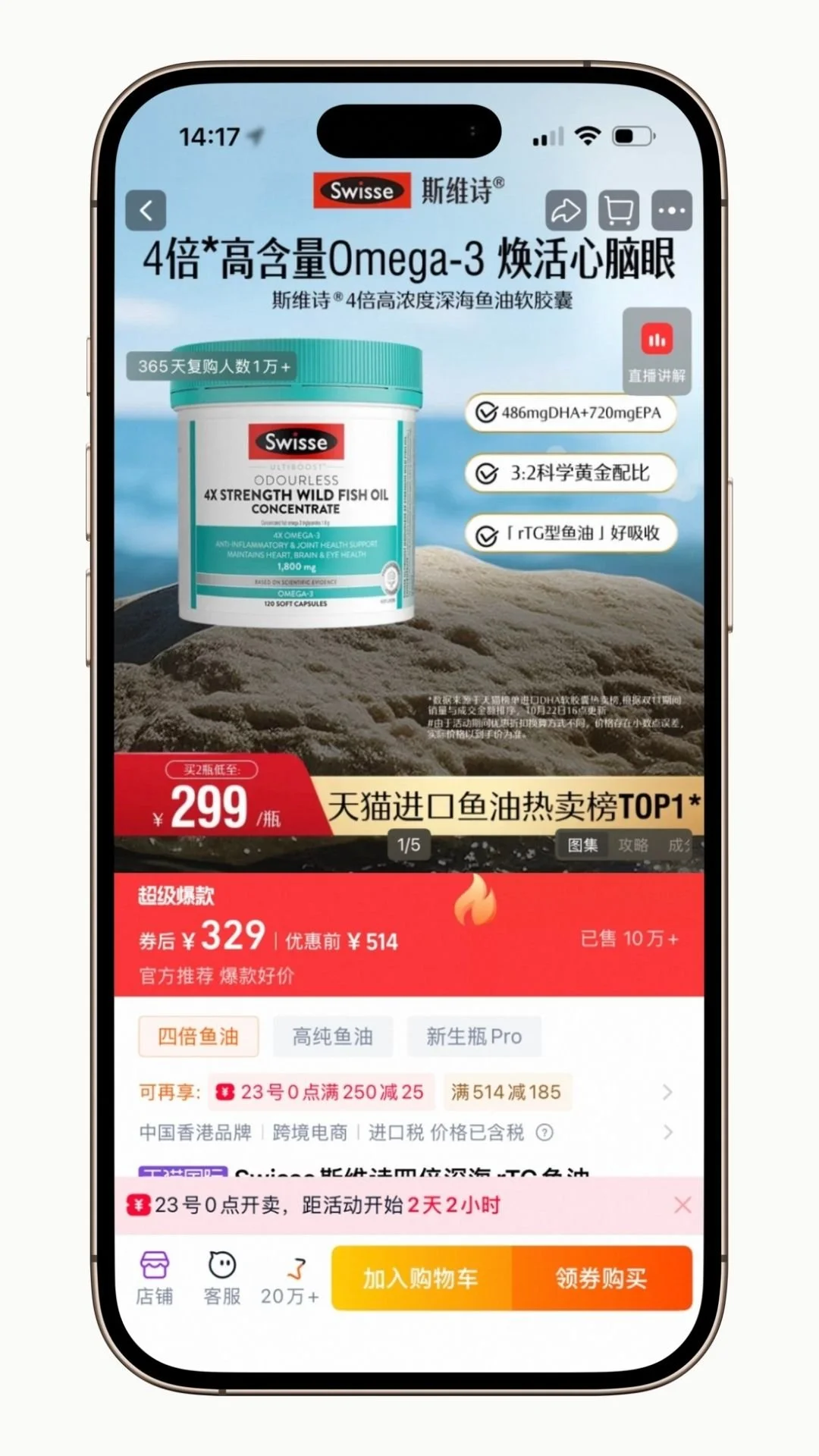
- Swisse (Australia) — the best-selling health supplement brand in China with 29% overall market share. Entered via daigou and CBEC, now has full domestic registration. Parent company H&H Group generates over 70% of total revenue from nutritional supplements
- Blackmores (Australia) — strong double-digit growth in fish oil specifically. China revenue AUD$48 million in recent quarter. Actively tailoring products to Chinese consumer preferences
- Nature Made (USA) — trusted for pharmaceutical-grade quality. Strong presence on Tmall Global. Appeals to consumers who prioritize US FDA manufacturing standards
- Noromega (Norway) — entered China via CBEC in 2018, reached cumulative sales of $100 million by 2024. Expanded aggressively into livestreaming with 150+ marketing staff in China
- GNC (USA) — tailoring products to local needs, strong brand recognition among fitness-oriented consumers
Where the gaps are
Despite strong incumbents, new brands continue to enter and grow. The opportunities lie in:
- Premium Nordic sourcing — Norwegian and Icelandic origin commands a price premium that Australian brands cannot match on provenance alone
- Ultra-high concentration formulas — most mass-market products are still at 30-50% EPA/DHA concentration. Brands offering 60-80% have clear differentiation
- Specific health targets — brain health for young professionals, eye fatigue for screen workers, prenatal DHA. These niches are underserved by the generalist leaders
- Format innovation — gummies, flavored liquids, and single-serve sachets are still relatively underpenetrated by foreign brands
Country-of-Origin Advantage
In few supplement categories does country of origin matter as much as fish oil. Chinese consumers actively research and compare sourcing — it's one of the first filters applied when evaluating products.
Consumer Origin Preference (Fish Oil)
Norway and Iceland sit at the top. The association between Nordic waters and pure, sustainable fish oil is deeply embedded in Chinese consumer perception. Brands from these countries can charge 20-40% more than comparable products from other origins.
Australia benefits from the Swisse and Blackmores halo effect. TGA certification is well understood and trusted. Australian brands do not need to educate consumers about their regulatory system.
The United States carries strong FDA recognition, but faces more complex brand positioning given broader geopolitical dynamics. US brands that lead with manufacturing standards and clinical backing tend to perform better than those relying on country branding alone.
Platform Strategy
Fish oil is a category where platform selection directly impacts margin and growth trajectory. Here's how the major platforms compare for omega-3 brands.
Tmall Global — primary platform
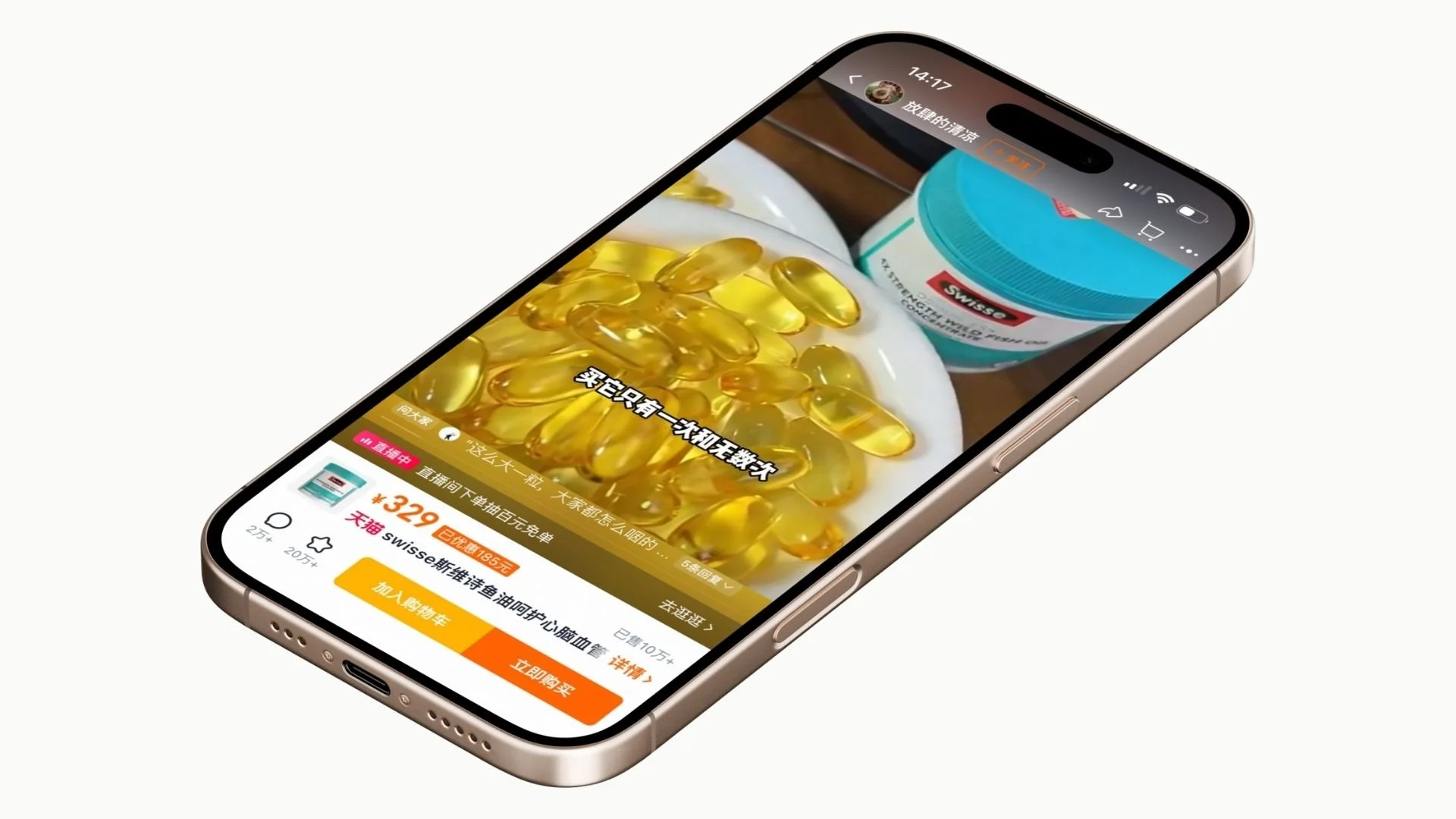
The dominant channel for imported health supplements. Fish oil is one of the top-performing categories. Tmall Global offers established consumer trust, built-in CBEC infrastructure (bonded warehouse, customs integration), category-specific promotional events (Health Day, 6.18, 11.11), and data tools to track competitor pricing and keyword performance.
JD Worldwide — secondary platform
Strong in health categories with a consumer base that skews slightly older and more male — a natural fit for cardiovascular-focused fish oil products. JD's logistics infrastructure and reputation for authenticity add credibility.
Douyin (TikTok China) — growth channel
Livestream commerce is transforming supplement sales in China. Noromega's success story — $100 million in cumulative sales with 150+ marketing staff focused heavily on livestreaming — demonstrates the channel's potential. Douyin works best for education-driven content explaining EPA/DHA benefits, before-and-after health content from KOLs, and flash sales during health awareness campaigns.
Little Red Book (Xiaohongshu) — discovery and trust
The platform where Chinese consumers research supplements before purchasing. Fish oil content on Little Red Book (Xiaohongshu) typically includes ingredient comparisons, unboxing reviews, and user experience posts. Essential for building the trust layer that drives Tmall conversions.
Marketing and KOL Strategy

Fish oil marketing in China requires a specific approach because it's a trust-intensive, education-heavy category. Consumers want to understand what they're taking, why the source matters, and how it compares to alternatives.
Content pillars
- Sourcing story — where are the fish caught? What species? Cold-water sustainability credentials? This is the content that differentiates premium brands
- Ingredient education — EPA vs DHA ratios, concentration levels, triglyceride vs ethyl ester forms. Chinese consumers compare these specs like they compare smartphone specs
- Certification proof — TGA, FDA, IFOS (International Fish Oil Standards), GMP badges. Make third-party validation visual and prominent
- Use-case targeting — cardiovascular health for older demographics, brain function for students and professionals, prenatal DHA for expecting mothers
KOL strategy by tier
- Micro-KOCs (1,000-50,000 followers) — product review and unboxing content on Little Red Book (Xiaohongshu). Budget: ~¥500-2,000 per post. Target 30-50 KOCs in the first three months for seeding
- Mid-tier health KOLs (50,000-500,000) — educational content comparing your product to competitors, ingredient deep-dives. Budget: ~¥5,000-20,000 per collaboration
- Livestream hosts on Douyin — product demonstrations with real-time Q&A. Particularly effective for fish oil because consumers have many questions about quality, dosage, and sourcing
Pricing and Positioning
Fish oil pricing in China follows clear tiers based on concentration, origin, and brand reputation:

Foreign brands entering via CBEC should generally target the mid-range to premium tier. The 9.1% CBEC tax rate gives you margin room that domestic competitors with Blue Hat registration costs cannot match. Avoid competing on price at the bottom end — Chinese domestic brands will always win on cost.
A strong entry strategy prices competitively against Swisse and Blackmores (the reference points consumers use) while offering a clear differentiation, whether that's higher concentration, better sourcing, or a unique format.
Market Entry Roadmap
A realistic timeline for launching a fish oil brand in China via CBEC:
Weeks 1-4: Foundation
- Confirm product eligibility on the CBEC positive list
- Select Tmall Partner (TP) for store operations
- Prepare brand documentation and certifications
- Begin Tmall Global flagship store application
Weeks 4-8: Setup
- Ship initial inventory to bonded warehouse
- Design Tmall store pages and product detail pages
- Create Chinese-language content and brand assets
- Begin Little Red Book (Xiaohongshu) KOC seeding (30-50 micro-influencers)
Weeks 8-12: Launch
- Go live on Tmall Global
- Activate paid search (Zhitongche) for target keywords
- Launch first mid-tier KOL collaborations
- Begin Douyin content testing
Months 3-6: Growth
- Optimize pricing and promotions based on early data
- Expand to JD Worldwide as secondary channel
- Scale KOL program and begin livestream commerce
- Prepare for first major promotional event (6.18 or 11.11)
Months 6-12: Scale
- Expand SKU range (gummies, liquid, combination products)
- Evaluate Blue Hat registration for top-performing products
- Build repeat purchase programs and loyalty
- Review unit economics and plan Year 2 strategy
Ready to sell your fish oil supplements in China?
Shanghai Jungle is a Tmall Partner with locations in Shanghai, Copenhagen, and Stuttgart. We help foreign supplement brands launch on Tmall Global through CBEC.
- CBEC store setup and product listing optimization
- KOL seeding and influencer campaign management
- End-to-end operations from logistics to customer service
Frequently Asked Questions
Is fish oil on the CBEC positive list?
Yes. Fish oil supplements are included on China's CBEC positive list, which means they can be sold through cross-border e-commerce platforms like Tmall Global and JD Worldwide without Blue Hat registration. This is the primary reason the category has grown so quickly for foreign brands.
How much does it cost to launch a fish oil brand on Tmall Global?
Budget approximately $30,000-$60,000 for the first six months including Tmall Global deposit and fees ($5,000-$10,000), initial inventory and warehousing ($10,000-$20,000), TP service fees ($3,000-$10,000/month), and initial marketing spend ($10,000-$20,000). Ongoing monthly costs typically run $8,000-$15,000 once the store is operational.
Can I sell fish oil in my original packaging?
Yes, CBEC products are exempt from Chinese labeling requirements. You can sell in your original international packaging, which actually works in your favor — Chinese consumers view original-language packaging as a signal of authenticity. Some brands add a Chinese-language supplement card with key product information, which is optional but recommended.
What EPA/DHA concentration should I target for the Chinese market?
Products with 60%+ combined EPA/DHA concentration are positioned as premium and command higher margins. If your current product line includes lower concentrations, consider leading with your highest-concentration SKU for the China launch. Chinese consumers actively compare these numbers across brands.
Do I need a Chinese entity to sell fish oil via CBEC?
No. One of the key advantages of CBEC is that you can sell directly from your overseas entity through a platform like Tmall Global. You will need a Tmall Partner (TP) to manage your store in China, but no local entity or business registration is required.
How does algae-based omega-3 perform compared to fish oil in China?
Algae-based omega-3 is growing at 11-13% annually in China, but fish oil still holds the dominant market share by a wide margin. Algae-based products appeal to vegetarian consumers and those concerned about sustainability, but fish oil's association with cardiovascular health and its established consumer education makes it the larger commercial opportunity for most brands.