

What Is JD.com?
A plain-language introduction to China's second-largest e-commerce platform and its largest direct-sales retailer — what it is, how it works, who uses it, and why it matters if you're thinking about selling in China.
What is JD.com?
JD.com (京东, jīngdōng) is China's second-largest e-commerce platform and the country's largest direct-sales retailer. Unlike Tmall, which is a pure marketplace, JD operates a hybrid model — it buys products from brands, holds inventory in its own warehouses, and delivers through its own logistics network, while also hosting third-party sellers on its marketplace platform.
Think of it as a combination of Amazon's retail arm and its marketplace. JD stocks and sells products directly (self-operated), but it also lets brands and retailers run their own stores on the platform. The self-operated side is what sets JD apart: consumers trust it for authentic products and fast delivery, because JD itself is the seller of record.
JD was founded in 1998 by Richard Liu (刘强东) as a physical electronics store in Beijing's Zhongguancun tech district. It moved online in 2004 and has since grown into one of the world's largest retailers by revenue. JD is publicly listed on NASDAQ (JD) and the Hong Kong Stock Exchange (9618).
For international brands, JD is most relevant if you sell electronics, home appliances, FMCG, or products where fast delivery and authenticity perception matter. If Tmall is the default for premium fashion and beauty, JD is the default for everything plugged in, consumed daily, or delivered fast.
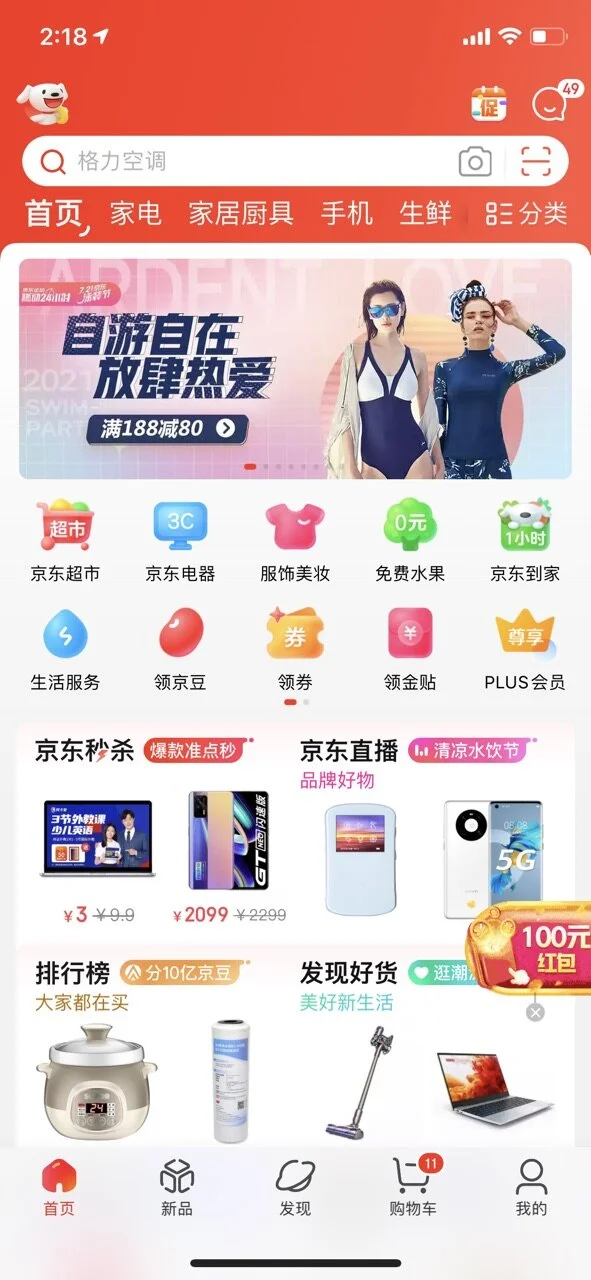
The JD app is where most purchases happen. The home screen surfaces personalized product recommendations, flash deals, live streams, and category navigation — all optimized for fast, habitual purchasing.
Self-operated products are prominently badged and prioritized in search results. JD’s interface is designed around trust signals: delivery time estimates, authenticity guarantees, and real-time logistics tracking.
For brands, the app experience matters because product detail pages, store design, and search ranking all directly affect conversion. This is where your customers encounter your brand.
JD is a retailer and a marketplace. On the self-operated side, JD buys your products wholesale and sells them directly. On the marketplace side, you operate your own store. This differs from Tmall, which is purely a marketplace — Tmall never buys or holds your inventory.
1998 as a physical electronics store in Beijing. Online since 2004. Part of JD Group. Listed on NASDAQ (2014) and HKEX (2020).
Both JD.com and Taobao maintain full desktop storefronts, though over 95% of purchases now happen on mobile. The desktop experience remains important for product research, brand storytelling, and high-consideration purchases.
JD’s desktop interface mirrors its mobile app: prominent self-operated badges, real-time delivery estimates, and category-driven navigation designed for efficient, trust-driven purchasing.
For brands, desktop product detail pages are where the bulk of buyers convert — making desktop optimization a worthwhile investment alongside mobile.

JD.com vs. Tmall
JD.com (京东)
JD operates as both a direct retailer and a marketplace. On its self-operated side, JD purchases products, warehouses them, and sells directly to consumers through its own logistics network. On its marketplace, third-party sellers operate their own stores. JD is strongest in electronics, appliances, FMCG, and categories where delivery speed and product authenticity are decisive.
Tmall (天猫)
Tmall is primarily a marketplace — brands operate their own flagship stores and manage pricing, content, and customer service, while Tmall provides the platform, traffic, and advertising tools. However, Tmall has increasingly adopted elements of a hybrid model, including self-operated channels and deeper involvement in fulfillment. It leads in fashion, beauty, luxury, and lifestyle categories, and remains the default destination for branded goods and official flagship stores in China.
Most successful foreign brands in China are present on both JD and Tmall. They are not direct substitutes — they serve different purchase occasions, category strengths, and consumer expectations. JD dominates when consumers want fast, reliable delivery of known products. Tmall dominates when consumers are browsing, discovering, or buying premium branded goods.
For a broader overview of the Chinese e-commerce landscape including JD, Tmall, and other platforms, see our What is Tmall guide.
JD.com vs. JD Worldwide
JD Worldwide (京东国际)
- No Chinese company required
- No Chinese product registrations (NMPA, etc.)
- Products ship from bonded warehouses or overseas
- Lower upfront investment
- Ideal for market testing before full commitment
JD.com (京东)
- Chinese company required (WFOE, JV, or partner)
- All products must pass regulatory approvals
- Goods warehoused and shipped within China
- Access to JD self-operated model
- Faster delivery, larger buyer pool
| Factor | JD Worldwide | JD Domestic |
|---|---|---|
| Chinese entity | Not required | Required |
| Product registration | Not required | Required |
| Security deposit | From $7,000Varies by category, refundable | $1,500 – $15,000Varies by category, refundable |
| Annual platform fee | $1,000/year | $0 – $1,700/year |
| Commission | 2% – 8%Per transaction, by category | 2% – 10%Per transaction, by category |
| Delivery | 1–15 days | Same-day / next-day (JD Logistics) |
| Best for | Market entry, testing demand | Established presence, scale |
JD Worldwide is JD's equivalent of Alibaba's Tmall Global. Like Tmall Global, it lets international brands sell cross-border without a Chinese entity. Unlike Tmall Global, JD Worldwide also offers access to JD's own logistics and warehousing network.
How JD.com Works
Two models: self-operated or marketplace
JD's self-operated model (自营) means JD buys your products wholesale, warehouses them, and sells directly to consumers. On the marketplace side, you operate your own store. Most foreign brands start with the marketplace model.
JD takes a commission or buys wholesale
For marketplace stores, JD earns a commission (2–10%) on each transaction. For self-operated, JD negotiates wholesale prices and sets the retail price. Self-operated gives you less control over pricing but access to JD's premium storefront and logistics.
Payments go through JD Pay
Transactions are processed through JD Pay (京东支付), which also supports WeChat Pay and major bank cards. Funds are settled to sellers on a regular cycle. For cross-border sellers, JD handles currency conversion.
JD Logistics handles fulfillment
JD operates one of China's largest proprietary logistics networks — over 1,600 warehouses and its own delivery fleet. Self-operated products get same-day and next-day delivery in major cities. Marketplace sellers can also use JD Logistics (Fulfilled by JD)
Advertising drives visibility
JD's search and recommendation algorithms heavily favor paid advertising. Key tools: JD Kuaiche (京东快车) for search ads, JD Showcase (京东展位) for display ads, and JD Express (京速推) for performance campaigns. Most brands allocate 10–30% of revenue to advertising in the long run, though startup marketing expenses can go much higher.
Customer service is expected in Chinese
Shoppers expect real-time chat support in Mandarin. JD tracks response times and customer satisfaction scores. For self-operated products, JD handles customer service directly. For marketplace stores, brands must provide their own Chinese-language support.
JD's proprietary logistics network is its single biggest differentiator. Same-day delivery in 300+ cities. Next-day delivery nationwide. This is why consumers trust JD for electronics, appliances, and everyday essentials — the delivery experience is consistently fast and reliable.
Products sold through JD's self-operated model display a "京东自营" (JD Self-Operated) badge. This badge significantly increases consumer trust and conversion rates — Chinese shoppers view self-operated items as guaranteed authentic with superior after-sales service.
Types of JD Stores
JD Self-Operated
JD buys your products at wholesale prices and sells them directly to consumers. JD controls pricing, product pages, and fulfillment. You get access to JD's premium storefront placement, the trusted "京东自营" badge, and JD's own customer service and logistics. Highest trust signal for consumers, but less brand control.
Flagship Store
The brand owner (or authorized agent) operates an official store on JD's marketplace. Requires a registered trademark. Full control over product listings, pricing, and branding. The standard for international brands who want to maintain brand control while accessing JD's traffic. Equivalent to a Tmall Flagship Store.
Specialty Store
An authorized retailer selling products from two or more brands within the same category. Requires authorization letters from each brand. Used by distributors and multi-brand retailers. Less trust than a flagship store, but useful if you don't want to operate a store directly.
Authorized Store
An authorized single-brand retailer operated by someone other than the brand owner. Requires brand authorization. Less common for international brands since flagship stores are preferred for brand control and consumer trust.
If you want maximum trust and fast delivery and are willing to give up some pricing control, explore JD Self-Operated. If you want full brand control over your store, pricing, and content, open a Flagship Store. Many brands do both — they list core products on JD Self-Operated for traffic and trust, while running a Flagship Store for their full range and brand storytelling.
What It Costs
These are platform fees for marketplace stores only. For JD Self-Operated, JD buys your products at negotiated wholesale prices — there are no separate platform fees, but your margin depends on the wholesale terms. Most foreign brands also budget for agency services, bonded warehouse fees, and marketing spend. A realistic first-year investment for a JD marketplace store typically starts at $7,000–28,000 USD depending on category and ambition.
Shopping Festivals
6.18 Anniversary Festival (京东618)
JD's biggest event and one of China's two mega shopping festivals. Celebrates JD's founding anniversary. Originally JD-exclusive, now cross-platform. Preparation starts in April. The single most important sales moment for JD sellers.
Singles' Day (双十一)
The world's biggest shopping event. Originally an Alibaba creation, JD is now a major participant. Electronics, appliances, and FMCG see enormous volume on JD during 11.11. Preparation starts in September.
Women's Day (妇女节)
Major shopping event targeting female consumers. Especially strong for beauty, fashion, health products, and household goods.
Double 12 (双十二)
Follow-up to Singles' Day. Good for clearing remaining inventory and capturing late-year demand before Chinese New Year.
Chinese New Year (春节)
Gifting-focused. Strong for food, health products, electronics, cosmetics, and premium goods. JD's logistics advantage is critical during this period when many competitors' delivery networks slow down.
JD Super Brand Day (京东超级品牌日)
JD assigns individual 24-hour events to qualifying brands. Premium homepage placement, dedicated traffic, and co-marketing support.
Many JD stores generate 30–50% of annual sales during shopping festivals. 6.18 is JD's signature event and typically the single largest revenue day for JD sellers. These are not optional — planning and preparation are essential.
Getting Started
Register your trademark in China
China uses a "first to file" system. File early — the process takes 6–12 months. You'll need a registered trademark to open any JD store.
Decide: JD Worldwide, Marketplace, or Self-Operated
No Chinese entity? JD Worldwide. Want full brand control? Flagship Store on JD's marketplace. Want JD to handle sales and logistics? Explore Self-Operated. Many brands combine models.
Choose a partner agency
Running a JD store requires native Chinese skills, platform expertise, and local logistics coordination. Most foreign brands work with an agency that manages daily operations, advertising, and customer service.
Apply and set up your store
Submit business documentation, brand authorization, and product information. All communication with JD is in Chinese. Expect 6–10 weeks for JD Worldwide, longer for domestic marketplace or Self-Operated stores.
Design your store and localize listings
JD product pages must be optimized for JD's search algorithm and designed for Chinese consumer expectations. This means Chinese copywriting, localized imagery, and mobile-first product detail pages — not just translations.
Launch, operate, and optimize
Daily operations, customer service, advertising, shopping festival campaigns, and continuous optimization. JD rewards stores with strong sales velocity, good reviews, and fast customer service response.
Common Misconceptions
JD started in electronics, but it's now one of China's largest platforms across categories. FMCG, grocery, health supplements, beauty, fashion, and home goods are all significant and growing. JD's investment in fresh food (JD Fresh) and daily essentials has transformed it from an electronics retailer into a full-spectrum commerce platform.
JD's self-operated model is one option, not the only one. The marketplace lets brands operate their own stores with full pricing and content control — exactly like Tmall. Many international brands use the marketplace model exclusively.
JD has over 600 million annual active customers and is the dominant platform in several categories. In electronics, home appliances, and FMCG, JD often outsells Tmall. For many product categories, ignoring JD means ignoring a significant share of the market.
Most successful foreign brands are eventually on both platforms. But trying to launch on multiple marketplaces at once spreads your budget and attention too thin. It makes more sense to start on one platform, build momentum, and expand from there. Tmall is typically the default starting point for most foreign brands, though the best choice ultimately comes down to your product category. JD is the stronger platform for electronics, appliances, and everyday consumer goods, while Tmall leads in beauty, fashion, and lifestyle.
JD Worldwide has grown significantly and offers something Tmall Global doesn't — access to JD's proprietary logistics network, even for cross-border sellers. Products can be stocked in JD's bonded warehouses and delivered through JD Logistics, which provides a near-domestic delivery experience for cross-border goods.
The Broader Ecosystem
Tmall (天猫)
China's #1 B2C e-commerce platform. Pure marketplace owned by Alibaba. The default for branded goods, fashion, beauty, and luxury. Most foreign brands start here.
Learn more →Little Red Book (Xiaohongshu)
China's leading lifestyle and discovery platform. Most consumers research products here before purchasing on JD or Tmall. Essential for brand awareness and social proof.
Learn more →Douyin
Short-video and live-streaming platform with an integrated e-commerce engine. Increasingly used for direct sales and brand discovery. China's answer to TikTok, but with built-in shopping.
Learn more →China's super-app — a CRM and private traffic channel for loyalty and repeat purchases. Not a direct JD competitor, but an essential part of any China e-commerce strategy. WeChat Mini Programs can integrate with JD for payment and fulfillment.
Learn more →For a complete guide to all major Chinese digital platforms and how they fit together: Chinese Digital Platforms: The Complete Guide →
Want to discuss whether
JD.com is right for your brand?
We've helped over 100 brands navigate the Chinese market since 2013. If you're considering JD, we're happy to give you an honest assessment.