
Tmall Global vs Douyin Shop vs Xiaohongshu Store: Where to Sell First
Tmall Global vs Douyin Shop vs Xiaohongshu Store: Where to Sell First
Three platforms, three completely different models. Here's how to decide which one deserves your budget, your team's attention, and your first 12 months in China.

Every foreign brand entering China faces the same question: where do I start? The answer used to be simple — open a Tmall Global store. But in 2026, the landscape has split into three genuinely viable first platforms, each with a fundamentally different model for reaching Chinese consumers.
Tmall Global is search-driven commerce: consumers know what they want and come to find it. Douyin Shop is content-driven discovery: consumers don't know they want your product until a video shows them. Little Red Book (Xiaohongshu) Store is community-driven trust: consumers buy because people they relate to recommended it.
Choosing the wrong first platform wastes both money and time — typically 6–12 months — because the content, operations, and team structure required for each platform are different enough that what you build for one doesn't transfer cleanly to another. This guide breaks down all three platforms across the dimensions that actually matter for your decision.
Why Your First Platform Choice Matters More Than You Think
The platform you launch on first shapes everything: your content strategy, your team composition, your budget allocation, and your timeline to first revenue. A brand that starts on Tmall Global builds a product-listing-first operation. A brand that starts on Douyin builds a video-production-first operation. These are fundamentally different capabilities, and building the wrong one first means rebuilding later.
More importantly, your first platform sets the benchmark for how your company evaluates the China market. If you launch on the wrong platform and underperform, the internal narrative becomes "China didn't work" when the real issue was channel selection. Brands rarely get a second chance to make the case for China investment internally.
The good news: for most foreign brands, there is a clearly better first platform. The decision depends on four variables — your product category, your budget, your content production capability, and your team size. We'll walk through each platform in detail, then give you a framework to make the call.
Tmall Global: The Search Engine of Chinese E-Commerce
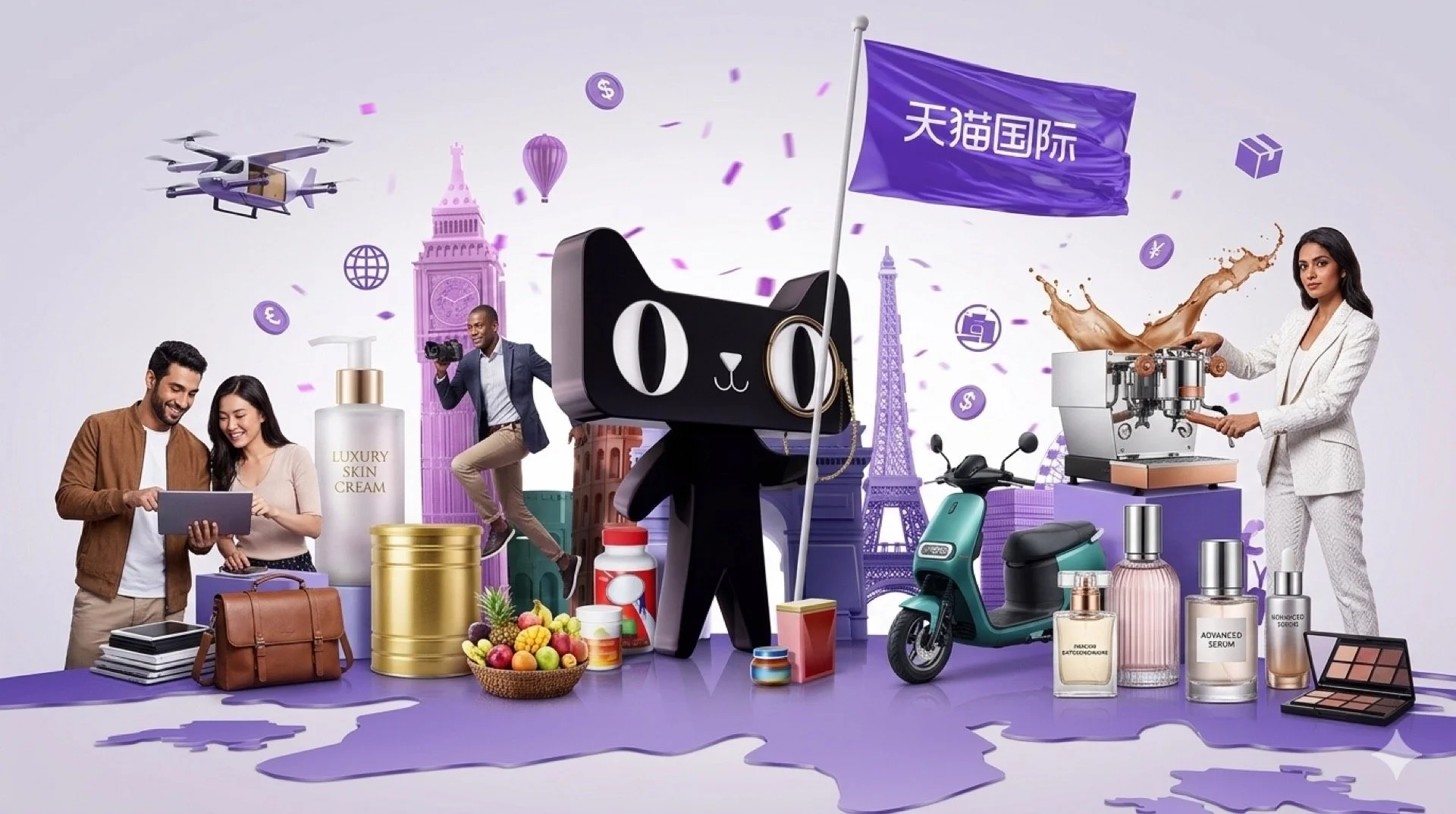
Tmall Global is Alibaba's dedicated cross-border e-commerce platform for foreign brands. Think of it as Amazon for imported goods, except brands run their own flagship stores with full control over pricing, listings, and customer experience. Consumers arrive with purchase intent — they search for a product, compare options, and buy.
For foreign brands, Tmall Global has the most mature cross-border infrastructure: no Chinese business license required, no domestic warehouse needed, established bonded warehouse and direct shipping logistics, and a well-understood regulatory framework for imported goods.
Who Tmall Global is best for
- Brands with established products that consumers already search for by category or name
- Health supplements, baby products, skincare, personal care, pet food, and premium food and beverage
- Brands prioritizing steady, search-driven revenue over viral content plays
- Teams with limited video production capability
- Companies that want a "store" presence that functions like their Western e-commerce setup
How it works
Consumers find your products through Tmall's internal search, category browsing, or increasingly through traffic driven from Xiaohongshu and Douyin. Your flagship store is a full storefront — hero images, product detail pages, brand story sections, and a customer review system. Conversion happens on-platform. Marketing is primarily paid search (Zhitongche), display advertising (Zuanshi), and participation in platform-wide campaigns like 618 and 11.11.
The economics
- Security deposit: $8,000 (refundable upon store closure)
- Annual fee: $5,000–$10,000 depending on category
- Commission: 2–5% of transaction value per sale
- Marketing budget: $2,000–$15,000/month for meaningful traction
- Agency/TP fee: $3,000–$8,000/month retainer plus 5–15% commission on sales
- Realistic Year 1 total: $100,000–$250,000
Strengths and limitations
Tmall Global's strength is predictability. Search-driven platforms produce more predictable, sustainable revenue than content-driven platforms. You can forecast based on keyword volume, conversion rates, and ad spend. The downside: customer acquisition costs are rising. Without supplementary traffic from social platforms, purely search-based growth is expensive and slow for unknown brands. Tmall doesn't do brand discovery well — it converts demand that was generated elsewhere.
Douyin Shop: The Content Engine
Douyin is TikTok's Chinese counterpart — and it has evolved into a full e-commerce platform. Commerce on Douyin is content-driven: a consumer scrolling through short videos encounters your product, gets interested, and buys without leaving the app. The entire journey from discovery to purchase happens in one swipe.
Cross-border capabilities for foreign brands are newer and less mature than Tmall Global's, but growing rapidly. Douyin's appeal is the massive audience and the potential for rapid, viral-driven sales — but this comes with higher operational complexity and content production demands.
Who Douyin is best for
- Brands with visually demonstrable products — beauty, fashion, food, gadgets, fitness
- Brands targeting consumers under 35
- Companies with existing video content capabilities or willingness to invest heavily
- Products suited to impulse purchase and emotional storytelling
- Brands with higher margins that can absorb content production and KOL costs
How it works
Revenue on Douyin comes from three channels: short video product links (a product card embedded in an organic or promoted video), livestreaming (real-time selling sessions hosted by the brand or by KOLs/KOCs), and Douyin Mall (the platform's search-based shopping tab, growing but still secondary to content-driven sales). The algorithm decides who sees your content — there is no follower-based distribution like on Western social media. Every piece of content competes on its own merits.
The economics
- Platform deposit: Lower than Tmall, varies by category ($1,000–$10,000)
- Commission: 1–5% of transaction value
- Content production: $2,000–$15,000/month for short videos and livestream support
- KOL/KOC campaigns: $3,000–$30,000/month depending on scale
- Ad spend: $2,000–$15,000/month for Dou+ and Ocean Engine campaigns
- Realistic Year 1 total: $80,000–$200,000
Strengths and limitations
Douyin's strength is discovery at scale. A single video can generate tens of thousands of sales overnight. The platform rewards great content regardless of brand size or follower count, which creates a genuine opportunity for unknown brands. The limitation: revenue is volatile. Content performance is unpredictable, and a brand's sales can swing 10x week-to-week depending on whether a video catches the algorithm. Building stable, recurring revenue on Douyin requires consistent content output and a diversified traffic strategy — which is expensive to maintain.
Xiaohongshu Store: The Trust Engine
Little Red Book (Xiaohongshu) — also known as RED — started as a product review community and evolved into a lifestyle platform with integrated e-commerce. Think of it as Instagram meets Pinterest meets product reviews, with a native shopping function. Users share genuine experiences, and this authenticity drives high trust and strong purchase intent.
The platform's strength is in specific categories where trust, aesthetics, and community validation drive purchase decisions: beauty, skincare, fashion, lifestyle, home décor, and wellness.
Who Xiaohongshu is best for
- Beauty, skincare, fragrance, fashion, and lifestyle brands
- Brands targeting educated, urban women aged 20–40
- Products where authenticity, aesthetics, and storytelling matter more than price
- Brands that can invest in high-quality photo and short-form content
- Niche or premium brands where community endorsement is more persuasive than search ads
How it works
Brands can open a Xiaohongshu store and sell directly, but the platform's real power is as a seeding and discovery channel. Users post "notes" — photo or video reviews, tutorials, and recommendations — that appear in feeds based on interest-matching algorithms. Commerce happens both within Xiaohongshu (direct purchase) and by driving traffic to external platforms like Tmall. Many brands use Xiaohongshu primarily for awareness and trust-building while converting on Tmall.
The economics
- Store deposit: Relatively low ($1,000–$5,000 depending on category)
- Commission: 2–5% of transaction value
- Content seeding: $3,000–$10,000/month for KOC and KOL collaborations
- Official account management: $1,000–$3,000/month
- Ad spend: $2,000–$8,000/month for Spotlight and branded content promotion
- Realistic Year 1 total: $30,000–$80,000 (as standalone) or $15,000–$40,000 (as supplementary channel)
Strengths and limitations
Xiaohongshu's strength is trust. Consumers on the platform are actively seeking authentic recommendations and are willing to pay premium prices for products that the community endorses. The cost of entry is lower than Tmall or Douyin, and the content format (photos and short notes) is less production-intensive than Douyin's video requirements.
The limitation: GMV ceiling. Xiaohongshu's e-commerce transaction volume is significantly smaller than Tmall's or Douyin's. The user base, while highly engaged, is narrower — predominantly female, urban, and concentrated in specific lifestyle categories. Brands outside beauty, fashion, and lifestyle may find the audience too niche to justify Xiaohongshu as a primary sales channel.

Side-by-Side Comparison
| Dimension | Tmall Global | Douyin Shop | Xiaohongshu Store |
|---|---|---|---|
| Commerce model | Search-intent | Content-discovery | Community-trust |
| Core audience | Mass market, all ages | 18–35, trend-driven | 20–40, female, urban |
| Cross-border maturity | Most mature | Growing rapidly | Limited but improving |
| Content requirements | Product listings, hero images | Daily video + livestreams | Photo notes, short videos |
| Revenue predictability | High (search-based) | Low (algorithm-dependent) | Medium (community-driven) |
| Year 1 investment | $100K–$250K | $80K–$200K | $30K–$80K |
| Time to first sale | 6–10 weeks | 2–6 weeks | 2–4 weeks |
| GMV ceiling | Highest | High (volatile) | Lower |
| Best for categories | Supplements, baby, skincare, food | Fashion, beauty, gadgets, food | Beauty, fashion, lifestyle, home |
| TP/agency support | Extensive TP ecosystem | Growing, less standardized | Smaller, more specialized |
Recommended Multi-Platform Rollout Sequence
Most successful foreign brands in China end up on multiple platforms within 12–18 months. The question is sequencing — and getting it right saves significant time and money.
Phase 1 — Months 1–3: Foundation
Launch your Tmall Global flagship store. Focus on getting the basics right: optimized product listings, competitive pricing, professional hero images, and initial advertising campaigns. In parallel, set up your Xiaohongshu official account and begin posting content — product shots, brand story, usage tutorials. No hard selling yet. The goal is building a content library and initial community presence.
Phase 2 — Months 3–6: Seeding
Begin Xiaohongshu KOC seeding campaigns: send products to 50–200 micro-influencers who create authentic review notes. This generates organic search volume on both Xiaohongshu and Tmall (consumers who discover your brand on Xiaohongshu often search for it on Tmall to purchase). Monitor which content angles, product variants, and messaging resonate with Chinese consumers.
Phase 3 — Months 6–9: Expansion
If budget and content capability support it, begin Douyin content production. Start with 3–5 short videos per week and test livestream selling with a hosted format. Use the consumer insights from Xiaohongshu seeding to inform your Douyin content strategy — you now know what messages and products resonate.
Phase 4 — Months 9–12: Integration
Optimize cross-platform traffic flow: Xiaohongshu seeding drives search interest, Tmall captures search-intent purchases, Douyin captures impulse and discovery purchases. Develop a unified content calendar that coordinates messaging across all three platforms around key shopping festivals (618, 11.11, 12.12) and seasonal moments.
Common Mistakes When Choosing a Platform
Mistake 1: Launching everywhere at once
Spreading a $100,000 budget across three platforms means none of them gets enough investment to succeed. Each platform requires dedicated content, dedicated advertising spend, and dedicated operational attention. It's better to do one platform well than three platforms poorly.
Mistake 2: Choosing based on hype instead of fit
Douyin's explosive growth generates a lot of excitement. But if your product isn't suited to video-driven impulse purchase, or if you can't sustain daily content production, Douyin will underperform no matter how big its audience is. Platform choice should be based on your product, budget, and capabilities — not on industry hype.
Mistake 3: Treating Xiaohongshu as a standalone sales channel
For most brands, Xiaohongshu works best as a top-of-funnel awareness and trust-building channel that feeds traffic to a Tmall store for conversion. Relying on Xiaohongshu alone limits your GMV ceiling. The combination of Xiaohongshu seeding + Tmall conversion is much more powerful than either platform alone.
Mistake 4: Ignoring platform-specific content requirements
Repurposing your Western marketing assets without localization doesn't work on any Chinese platform. Each platform has its own content format, aesthetic standard, and communication style. Tmall requires localized product detail pages. Douyin needs native-feeling video content. Xiaohongshu rewards authentic, editorial-quality notes. Budget for content localization on whatever platform you choose.
Mistake 5: No conversion destination before seeding
Starting with Xiaohongshu or Douyin content campaigns before having a functional Tmall store is like running ads without a landing page. You'll generate interest with nowhere to capture it. Always have your conversion infrastructure ready before turning on the awareness machine.
Frequently Asked Questions
Which Chinese e-commerce platform should a foreign brand start with?
Can foreign brands sell on Douyin without a Chinese business license?
Is Xiaohongshu a good e-commerce platform for foreign brands?
Should foreign brands sell on multiple Chinese platforms at once?
How much does it cost to open a store on Tmall Global vs Douyin vs Xiaohongshu?
Not Sure Which Platform Fits Your Brand?
We help foreign brands choose the right first platform based on category, budget, and competitive landscape — then manage the full launch.
- Official Tmall Partner with cross-category experience
- Active operations on Tmall, Douyin, and Xiaohongshu
- Multi-platform rollout strategies for 100+ brands
- Shanghai-based team with European management

"The best platform is the one that matches your product, your budget, and your team's capabilities — not the one with the biggest headline numbers."— Shanghai Jungle