Livestreaming in China
A practical guide for EU SMEs, from planning to execution. The video is Nora Liu's session at the EU SME Centre and CICC seminar on 6 November 2026.
Livestreaming in China can look hard to enter from Europe. This guide sets out a practical way to plan and run a campaign, from the first setup choices through costs, common pitfalls, and two real campaigns.
It covers how to get started, which platform to use, how to choose partners, how a campaign actually runs, what it costs, and what often goes wrong. The two case studies are Rosso Caffè on Douyin, and Graccioza, a Portuguese luxury textile brand, on Xiaohongshu (Little Red Book).
Shanghai Jungle is a European agency based in Shanghai and a Tmall Partner. The firm has been active in China since 2013 and has launched or managed 100+ foreign brands. It runs stores, content, influencer work and livestreams, and also supports import, warehousing, trademarks and exhibitions.
A livestream is like an exhibition. The event itself may last a few hours. The preparation takes much longer, and that work decides the result.
The first distinction that shapes every later choice is between a brand store stream (店播) and an outsourced livestreamer (达播).
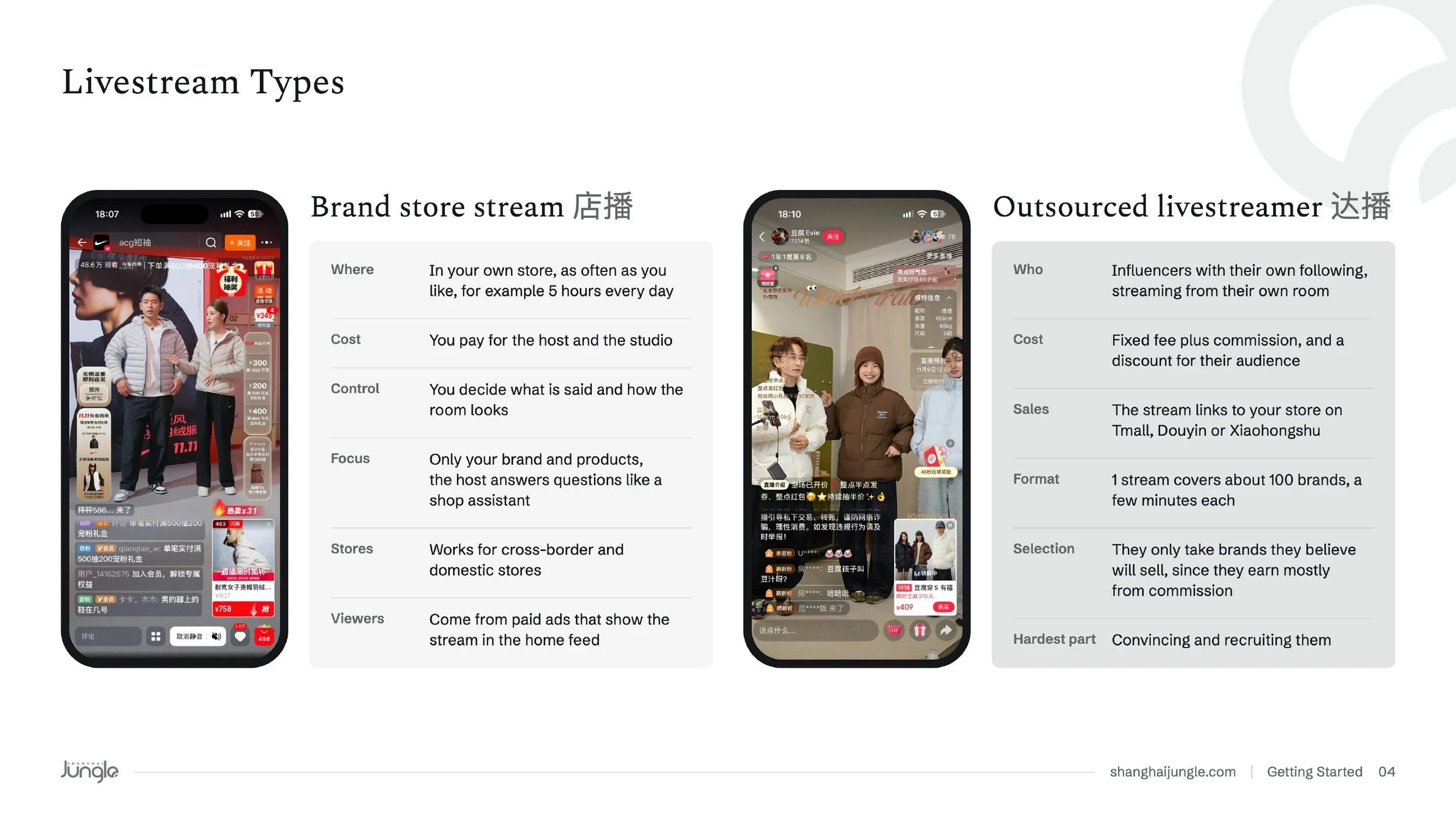
Brand store stream
店播 / your storeThe stream happens in your own store, as often as you like, for example 5 hours every day. You pay for the host and the studio, so you decide what is said and how the room looks. The host works like a shop assistant, answering questions about your brand and products only. This works for both cross-border and domestic stores. Viewers come from the shop itself and from paid ads that show the stream in the home feed.
Outsourced livestreamer
达播 / their roomThese are influencers with their own following, streaming from their own room. You join a stream that may cover about 100 brands, with a few minutes for each product. Cost is a fixed fee plus commission, and a discount for their audience. A tap on a product opens the page in your store on Tmall, Douyin or Xiaohongshu. Your store then handles the order, shipping, customer service and returns. The hard part is convincing and recruiting livestreamers who believe they can sell your product.
Before an outsourced stream, the live price, stock and coupons already have to be in the store. The platform tracks every order back to the livestreamer, so commission is calculated automatically.
The sales model also matters. Cross-border is especially useful for categories that are slow to register for domestic trade, such as perfumes, cosmetics or supplements, where registration can take months or more than a year. With a cross-border model you can start selling without a Chinese company or Chinese product registration. Fewer livestreamers will take a cross-border brand, because of purchase limits and the cost of returns. A domestic model has fewer of those limits, and asks for more documentation.
There are 6 things to have in place before the first stream.
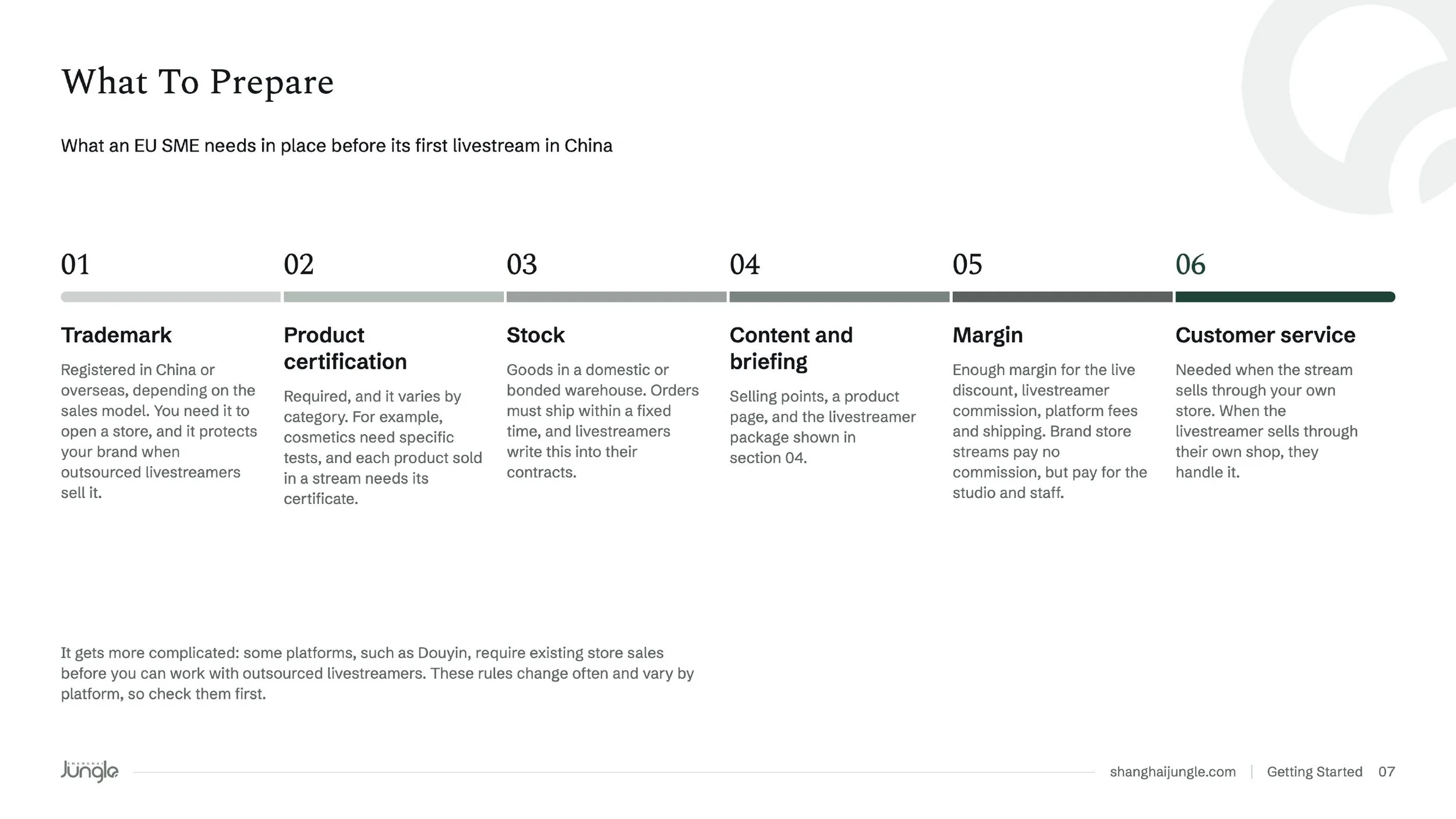
Trademark
Registered in China or overseas, depending on the sales model. You need it to open a store, and it protects your brand when outsourced livestreamers sell it. Filing should start early. See our note on China trademark registration.
Product certification
Required, and it varies by category. Cosmetics, for example, need specific tests, and each product sold in a stream needs its certificate.
Stock
Goods in a domestic or bonded warehouse. Orders must ship within a fixed time, and livestreamers write this into their contracts. Some of the best livestreamers check your stock level before they confirm, and some ask you to prepare extra stock for the campaign.
Content and briefing
Selling points, a product page, and a livestreamer package. KOC or user content posted before the campaign helps, so people who search for the brand during the stream already find reviews and results.
Margin
Enough margin for the live discount, livestreamer commission, platform fees and shipping, and still a profit. Brand store streams pay no commission, but you pay for the studio and staff.
Customer service
Needed when the stream sells through your own store. When the livestreamer sells through their own shop, they handle it. Return rates from livestreams can be high, so this work continues after the stream ends.
Some platforms, such as Douyin, require existing store sales before you can work with outsourced livestreamers. These rules change often and vary by platform, so check them first.
For livestreaming in China, a few platform points matter most. Tmall has become a destination for brand shopping. Xiaohongshu and Douyin have grown their e-commerce functions. Xiaohongshu is a good fit for premium and niche brands, especially in design, beauty and home. JD.com is known for electronics and appliances. Douyin used to be known for cheap products, which is changing.
Fits brands with a sufficient marketing budget. Traffic comes from the algorithm and paid ads (Qianchuan). Buying is impulse, driven by the deal. Most products are under ¥200 / €30, though premium also works in brand stores. A steady Qianchuan ad budget is needed from day 1.
Fits brands with an established Tmall store. Shoppers already search or visit the store and compare brands. Streams are mainly brand store streams inside the Tmall store, plus livestreamers in cosmetics. Price point often ¥200 to ¥800 / €30 to €110.
Followers and search in a lifestyle community. The mood is research, trust and recommendation. Streams are calm and close to a product review. Start with influencer posts, a few thousand yuan a month.
Shoppers search with a clear intent and look for genuine goods and fast delivery. Mostly brand store streams, with few big livestreamers. JD ads bring viewers.
Two Helena Rubinstein examples from a Douyin store show that Douyin now sells premium as well as cheap impulse deals. A skincare set at ¥4,340 / €580 was sold in the brand's own store stream for Double 11, presented by the brand's own host. A 50 ml face cream at ¥3,980 / €530, the brand's best known cream in its Douyin flagship store, had sold over 100,000 units.
Once the shop and platform are in place, the next step is to choose who will help you sell. There are 4 partner types. Our overview of influencer marketing in China and the comparison of KOLs and KOCs give more background on the influencer side.
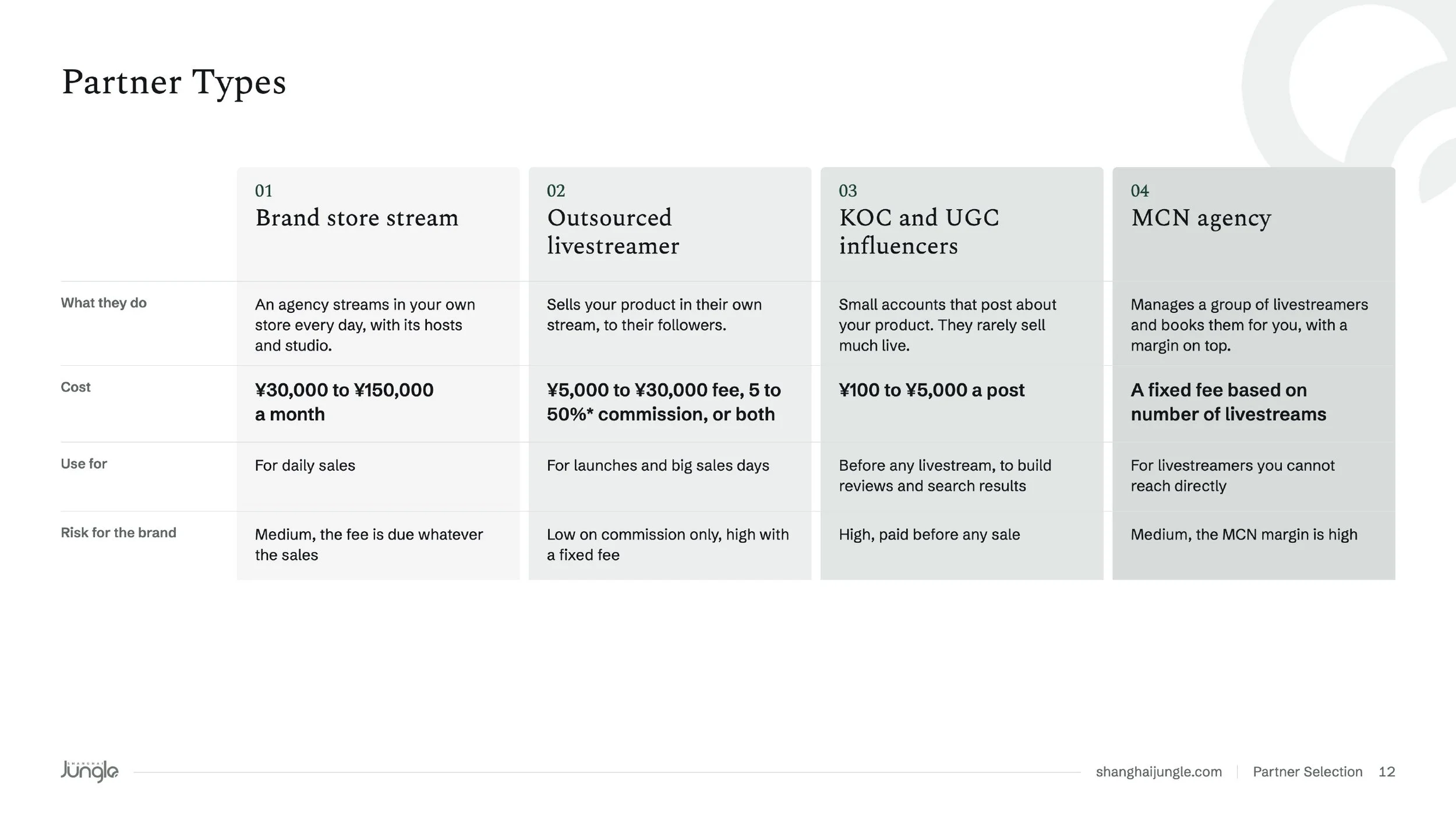
An agency streams in your own store every day, with its hosts and studio. Cost is mostly a fixed fee. Risk is medium, because the fee is due whatever the sales.
Sells your product in their own stream, to their followers. Cost is a fee, commission, or both. Risk is low on commission only, and high with a large slot fee.
Smaller accounts that post about your product. They rarely sell much live. Use them before a livestream, to build reviews and search results. Risk is high if you pay a large fee up front, because they do not sell directly.
Manages a group of livestreamers and books them for you, with a margin on top. Useful for livestreamers you cannot reach directly. Risk is medium, and the MCN margin is high. Verify the short list they send you yourself.
Before you book an outsourced livestreamer, check whether they can sell your product at your price, to the right buyers. The checks below are the ones to run in a data tool.
Start with sales rather than follower counts. Look at what they sold in the past, and whether they are active in your category. In one example, sales per stream were about €267,000 to €600,000, which sounded strong, but 86% of those sales were in women's clothing. If your category is not among their top sellers, that headline sales figure tells you less. She also described a livestreamer who sold expensive jackets well, and looked like a fit for a textile brand, until the collaboration itself did not perform. Category fit matters more than a large sales total.
Then check the commission they already take in their main category. In that same example it was 32 to 35% for women's clothing, which tells you what they will expect from you. Commission varies by category. Supplements can run up to 40 or 50%. Food can be much lower, even 5 to 15%.
Check how crowded the stream is. One livestreamer had promoted 64 brands in the last 30 days, which gives you a sense of how much airtime you will get. Check whether they can sell at your price, next to brands like yours. In one case the top seller was priced at about €250, but over 47% of products sat in a cheaper range. A product at several thousand RMB may not belong in the same stream as very cheap home goods, because that pairing can damage the brand.
Check buyers as well as viewers. Look at how many viewers actually order, and how often the livestreamer goes live. In one example, over 66,000 followers had ordered from the livestream, and more than half of them had purchased on Xiaohongshu. Average watch time was 3 minutes. If your product needs a longer explanation, such as a supplement, confirm that in advance. Also look at streams per month. Three streams in one month helps you estimate when the next slot might be.
Finally, check whether their followers match your buyer. In one example, 92.9% were women, 64.1% were aged 25 to 34, and the leading provinces were Guangdong, Zhejiang and Jiangsu, richer coastal provinces. Interests were entertainment, fashion and lifestyle. For Xiaohongshu, which leans toward lifestyle and higher end brands, followers in first or second tier and coastal cities are a useful sign of purchase power.
If the shop is already established on a platform, the first livestream can start sooner. Negotiation and stock work take longer the first time. Repeat streams are faster. An ideal timeline starts about 4 weeks before an outsourced stream.
Four weeks out, set the goal, products, live price and livestreamer shortlist. Then send the contract and samples. Before the stream, post influencer content on Xiaohongshu to warm the campaign up, and prepare the livestreamer package, with a product list, visual guidelines and a live cue card. Get stock into the warehouse and agree a customer service script. On the day, someone still needs to help the livestreamer with unexpected questions and with any issue on the product link. After the stream, ask whether you can reuse clips, handle returns and after sales questions, and only calculate the final numbers once the return window closes.
A brand store stream in your own studio follows a different clock. Everything can be ready within 2 to 4 weeks. An outsourced livestreamer's slot can be next week or 2 months away, depending on their schedule.
To reach an outsourced livestreamer, start with a short brand brief that includes the brand story, unique selling points and a suggested live price. Most livestreamers want to try samples before they say yes. Large livestreamers have selection teams that handle pitches. Smaller ones decide themselves. Expect few replies. They are busy and may miss messages, so follow up if you hear nothing. Bigger names are pickier, charge higher fees and commission, and may receive a bunch of samples and return all of them. An MCN can handle some of this outreach. Verify whatever they tell you with the checks above.
The product list is a spreadsheet the livestreamer expects early. It includes store links, sizes, stock, list price and live price, gifts, the main selling points, a short brand story, suggested discounts and the commission, so everyone works from the same deal. Visual guidelines show the livestreamer and the influencers how to present the product, including packaging, care cards and what other home products can sit beside it. The live cue card is the simple page they use during the stream, with pictures, prices and shipping terms.
Three worked examples make the same point. What matters is not the headline sales figure. It is what the brand keeps after fees, shipping, samples and product cost.
The small deal used an outsourced livestreamer. Live sales of ¥150,000 / €20,000 were already after a 30% discount. The livestreamer fee was €3,000 plus 30% commission. After that fee and commission, the platform fee, shipping and packaging, samples, giveaways, ads and product cost, brand profit was close to €4,000, about 20% of live sales. Average order was about €120, with about 167 orders.
The large deal used Austin Li (李佳琦), also known in China as the Lipstick King, as a Taobao livestreamer in the example. The numbers are for reference and are not an exact quotation. Live sales after a 25% discount were ¥1,000,000 / €133,000. After a €16,000 fixed fee, 30% commission, platform fees, shipping, samples, ads and product cost, brand profit was ¥219,398 / €29,000, or 22% of live sales. Average order was about €110, with about 1,205 orders. A jump in volume like this also has to be a volume your shop and team can fulfil.
The third example is a one month brand store stream, a more realistic picture for an SME than a campaign with Austin Li. The livestreamer and studio cost about €4,000 a month, with an agency fee of €3,000 a month, and streaming of 3 hours every workday. Ads were another €4,000 a month. Product cost was assumed at 34% of sales. Douyin commission was 5%, the discount 5%, and shipping about €1 per order, with an average order of €30. Monthly live sales after discount were ¥200,000 / €27,000. After all deductions, brand profit was ¥34,000 / €5,000, or 17% of live sales. The shop would need about ¥140,000 / €19,000 of monthly sales to break even. The live question is whether sales can cover the cost, month after month.
Brands often make 7 mistakes. Here is how to avoid them.
A big slot fee for a famous livestreamer
Aim for commission based deals, or a fee tied to completed sales, especially as a beginner.
Going live with an empty store
Customers check reviews and performance before they buy, and good livestreamers check your sales and product pages before they work with you. Build reviews and a sales history first.
A live price that undercuts your other channels
Plan prices across all channels for the weeks around the stream.
Counting live sales instead of net sales
Judge a session after returns, and pay commission after the return window closes.
Clips that belong to the livestreamer
Ask whether you can reuse stream clips later, and write that right into the contract. Usually only smaller livestreamers agree.
Trusting views and follower counts
This often happens when working with MCNs, who may send attractive numbers. Check completed orders in a data tool. Views and followers are easy to fake.
A high return rate after the stream
Returns jump when the livestreamer's audience does not match the brand. Check the fit first, and ask for their return rate in your category.
Public cases also show brands that paid large livestream fees and sold little. One celebrity stream paid ¥3 million / €400,000 and sold ¥348,000 / €46,000, with over 50% of orders returned. A top Kuaishou team reported ¥37 million / €4.9 million and completed ¥9 million / €1.2 million, with about 80% of sales refunded and more than ¥8 million / €1.1 million in fees. A shampoo brand paid an actor ¥3 million / €400,000 for one 618 stream and sold ¥200,000 / €27,000, then tried to get the fee back. Another brand paid ¥530,000 / €71,000 in fees and sold ¥3,672 / €490. Read the contract with care.
Two Shanghai Jungle campaigns are useful for an SME because the results are modest and realistic.
Rosso Caffè on Douyin
Rosso Caffè is a small coffee brand, new to China, testing the market with its own store stream on Douyin on a small budget. The stream ran 5 days a week, 3 hours a day, as a brand store stream. Paid Qianchuan ads pushed the stream into the home feed. ROI on the stream, sales divided by ad spend and livestream spend, was about 1.7.
The host displayed the product and showed how to make capsule coffee during the stream. Buttons on the screen let viewers join a lucky draw for free mugs, which helped keep people in the room and move them to the product page, where they could also see other products in the shop.
Graccioza on Xiaohongshu
Graccioza is a Portuguese family company with luxury textiles, a niche brand promoting on a small budget. This kind of brand is a strong fit for Xiaohongshu, which is known for lifestyle recommendations and design ideas. In a quieter, more minimal stream, viewers can see the product next to other well designed pieces.
The campaign used 23 livestreamers and reached ¥701,342 / €94,000 in sales. Results were uneven. Nine of the 23 sold less than ¥3,000 / €400. One livestreamer sold ¥161,036 / €21,000, or 23% of the total.
For one of the stronger livestreamers, two week live sales were ¥110,000 / €15,000. After a 30% livestreamer commission, 6% platform commission and 5% shipping and packaging, €9,000 remained. After a 14% slice for fee, samples, giveaways and ads, €7,000 remained. After 15% product cost, ¥33,767 / €5,000 was left, or 31% of those live sales.
Most sales came from a few livestreamers. Rebook the ones who can sell. Start on commission, and pay a fixed fee only for livestreamers who have already sold. Read the contract first. In this campaign, the deal with the top livestreamer offered a 45 day lowest price clause and no sales guarantee.
For questions, contact Nora Liu, Marketing Manager, at nora@shanghaijungle.com, or shanghaijungle.com.
Frequently Asked Questions
What is the difference between a brand store stream and an outsourced livestreamer?
A brand store stream happens in your own store, as often as you like. You pay for the host and the studio, control what is said, and the host presents only your products. An outsourced livestreamer is an influencer with an existing audience, streaming from their own room. You join a stream that may include many other brands, each for a few minutes, and you usually pay a fee plus commission. The stream links back to your store, which still handles orders, shipping and returns.
What does a brand need before its first livestream in China?
A brand needs 6 things in place. They are a trademark registered in China or overseas, depending on the sales model, product certification for each item in the stream, stock in a domestic or bonded warehouse that can ship on time, content and a briefing pack, enough margin for discounts, fees and shipping, and Chinese language customer service if sales go through your store. Some platforms, including Douyin, also require existing store sales before you can work with outsourced livestreamers.
How much does livestreaming in China cost?
It depends on the partner. A brand store stream agency may charge ¥30,000 to ¥150,000 / €4,000 to €20,000 a month. An outsourced livestreamer may charge ¥5,000 to ¥30,000 / €670 to €4,000 as a fee, 5 to 50% commission, or both. In the worked examples, a small outsourced deal with €20,000 of live sales left about €4,000 of brand profit (20%), and a one month brand store stream with €27,000 of live sales left about €5,000 (17%), breaking even at about €19,000 of sales a month. What the brand keeps after fees matters more than the headline sales figure.
Which platform should an EU SME use for livestreaming in China?
Choose by product, audience and budget. Douyin fits brands that can fund a steady Qianchuan ad budget and often sells on impulse, including premium products in brand stores. Tmall and Taobao Live fit brands that already have a Tmall store with traffic. Xiaohongshu fits premium, design, beauty and home products, and can start with influencer posts on a smaller budget. JD.com fits electronics, appliances, baby and premium food, and is mostly brand store streams.
Should a new brand pay a large slot fee for a famous livestreamer?
Avoid this as a starting point. Aim for commission based deals, or a fee tied to completed sales, until you have evidence that a livestreamer can sell your product. In the Graccioza campaign, 9 of 23 livestreamers sold less than €400, while one livestreamer sold €21,000. Rebook the few who sell, and read the contract, including any lowest price clause and whether there is a sales guarantee.
Plan a Livestream Campaign in China
Shanghai Jungle is a European agency and Tmall Partner based in Shanghai since 2013. The team helps foreign brands run stores, content, influencer work, and livestreams in China.
- Store setup and livestream operations on Douyin, Tmall, and Xiaohongshu
- Partner selection and campaign planning for EU SMEs
- A practical path from the first stream through after sales work